Introduction
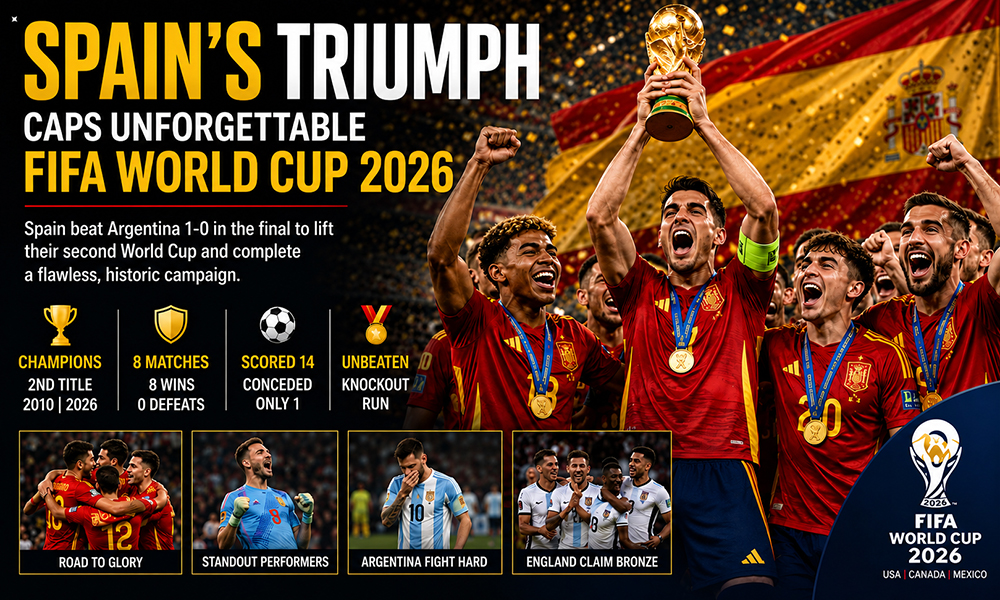
The 2026 FIFA World Cup concluded with a final that pitted the old guard against the new, as Argentina's quest for a third consecutive title was thwarted by a Spanish side brimming with youthful vigour and tactical discipline. The 1-0 scoreline in favour of La Roja, secured by a solitary goal, underscored a tournament where defensive solidity and clinical efficiency reigned supreme. For the discerning observer, this final was not merely a contest of attrition but a testament to the evolving paradigms of international football, where physical attributes such as acceleration, stamina, and aerial dominance are increasingly complemented by cerebral positioning and collective pressing.
The Road to the Final: A Chronicle of Resilience
The tournament, held across North America, delivered a series of compelling narratives. Argentina, inspired by the ageless Lionel Messi, demonstrated their trademark resilience, particularly in a dramatic semi-final against England. Trailing 1-0, the Albiceleste mounted a stirring comeback to secure a 2-1 victory, a result that underscored their psychological fortitude. England, for their part, showcased a blend of youthful pace and tactical organisation, yet ultimately fell short against the champions' experience. Spain, meanwhile, navigated a challenging bracket with a squad that blended the precocious talent of Lamine Yamal with the midfield mastery of veterans, culminating in a final that was as much a tactical chess match as a physical battle.
Tactical Evolution: Physicality Meets Intelligence
This World Cup highlighted a shift towards high-pressing systems that demand exceptional physical conditioning. Teams that advanced deep into the knockout stages, such as France and Spain, exhibited remarkable stamina and recovery capabilities, allowing them to sustain intense pressing for the full 90 minutes. The ability to accelerate from a standing start, both in attack and defence, proved decisive in transition moments. Spain's winning goal in the final, for instance, originated from a rapid counter-attack where the speed of their forwards stretched the Argentine backline, creating the space for the decisive strike. This interplay between raw pace and positional awareness is a hallmark of modern champions.
Player Profiles: The New Guard and the Old Masters
Lamine Yamal, at just 18, emerged as the tournament's breakout star, his low centre of gravity and explosive acceleration confounding defenders throughout. His ability to change direction at speed, coupled with a keen eye for a final pass, made him a constant threat. On the other side, Messi, though no longer possessing the blistering pace of his youth, compensated with an uncanny ability to read the game, often dropping deep to orchestrate play. His physical decline, however, was evident in the final, where Spain's younger, more athletic midfielders consistently denied him time and space. This juxtaposition of generations was a recurring theme, illustrating how physical attributes can be optimised or mitigated through tactical acumen.
The Psychology of Champions: Mental Resilience Under Pressure
Beyond the physical, the tournament was a study in psychological resilience. Argentina's comeback against England, and Spain's composed performance in the final, were testaments to the mental fortitude required at this level. The ability to maintain focus during high-pressure moments, such as penalty shootouts or late-game surges, proved as crucial as any sprint or jump. Spain's defensive organisation, marshalled by a veteran backline, reflected a collective psychological strength that withstood Argentina's late onslaught. This mental edge, often cultivated through experience and rigorous preparation, is a vital component of a champion's profile.
Conclusion
The 2026 World Cup will be remembered for Spain's triumph, a victory that symbolised the sport's evolution towards a more holistic approach, where physical attributes are harmonised with tactical intelligence and psychological strength. For aspiring players and coaches, the tournament offered a masterclass in the importance of acceleration, stamina, and mental resilience. As the footballing world looks ahead to the next cycle, the lessons from this tournament will undoubtedly shape training methodologies and tactical philosophies. For those seeking to refine their understanding of these attributes, platforms like SokaFundi provide invaluable insights and tools to analyse and develop the next generation of champions. The beautiful game, as ever, continues to evolve, and those who adapt will thrive.
